How you play
Make the choice, then see what really happened
At every decision you get a handful of orders. One of them is what Napoleon really did, but you are not told which. You decide with what you know at that moment: the weather, the reports, the people around you. Only afterwards does the seal break.
Four kinds of choices
Every option has a label that you see after choosing. Historical is what really happened. Plausible could easily have happened. Daring is a bold turn that history did not take. Free means you let go of history altogether. If you prefer to see the labels beforehand, you can switch that on in the menu.
What we know, and what we do not
After each choice you read what really happened, in a few sentences, with the uncertainty left in: where sources disagree or a story is only tradition, we say so. Some choices have no historical answer at all, like what you write to your mother. Then the choice is simply yours.
A different story every time
Your choices change the story. Call off the assault on Little Gibraltar and Toulon does not fall in December. Believe a lying deserter and your men feel deceived. Offer Admiral Hood a free withdrawal and Saliceti calls you suspicious in his report to Paris. Play again and you find out what else could have happened.
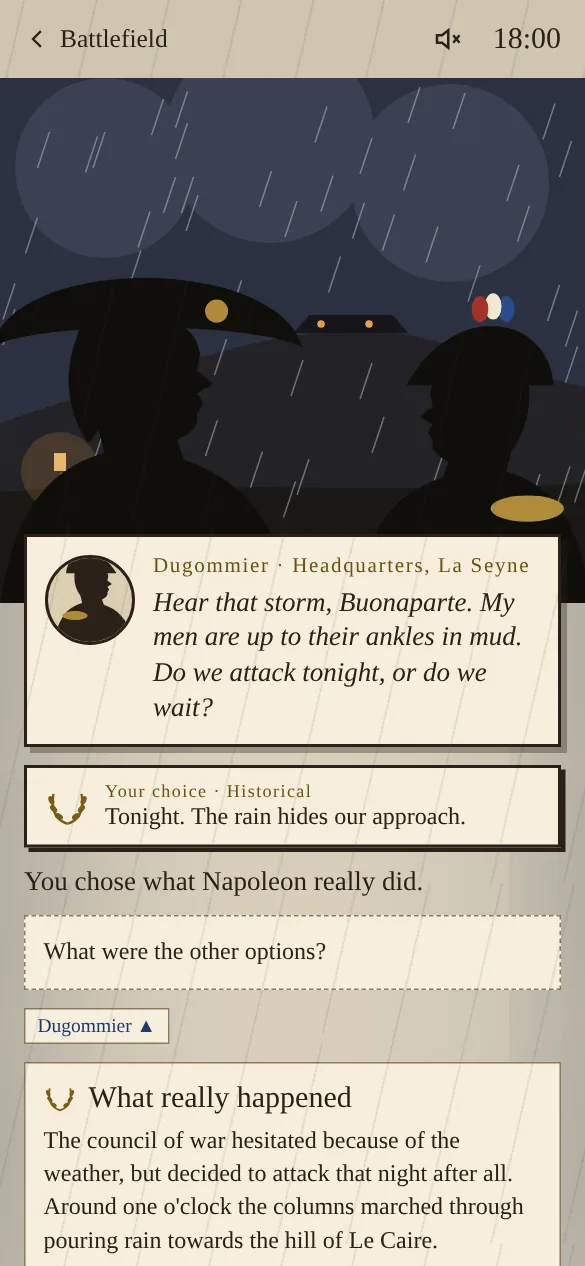
“You chose what Napoleon really did.”After the choice · Episode I: Toulon
Questions
About choose, then see the truth
Can I win or lose?
Not in the usual sense. Every ending is an ending. Your medal shows how close you stayed to history.
Is the history accurate?
The events, people and dates are real. Scenes and dialogue are written for the game, and every departure from history is labelled.
Can I see the labels before choosing?
Yes, you can switch that on in the menu of the game.